



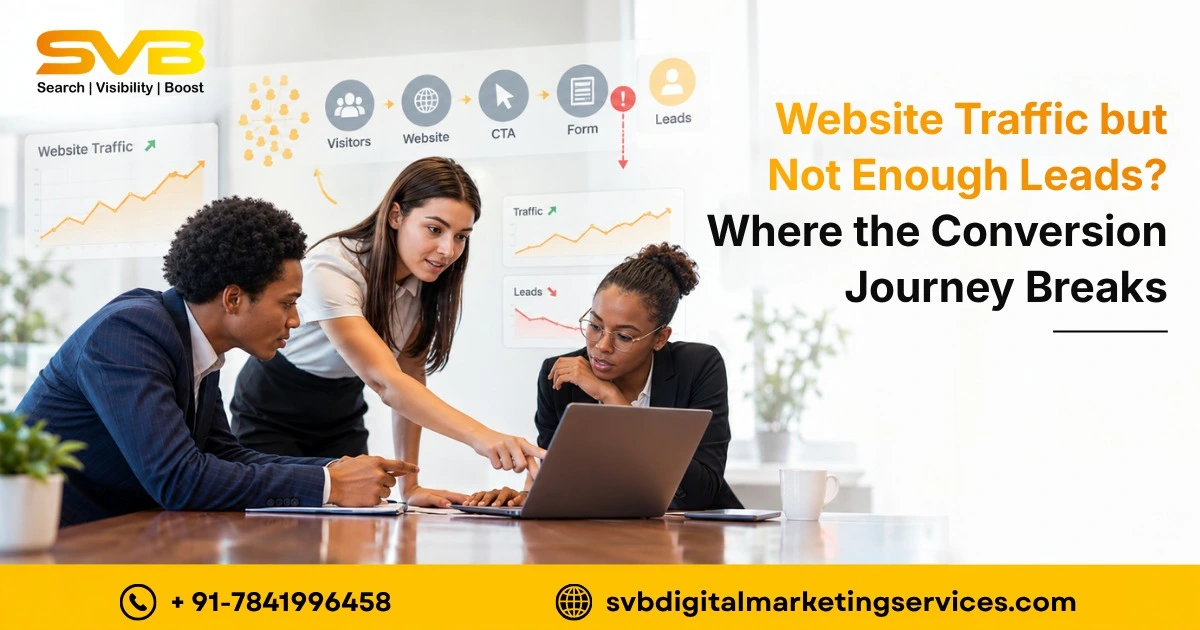
Your website is getting visitors. The numbers in Google Analytics may look healthy. Search traffic is growing, people are clicking your ads, and your social posts are sending users to the site.
But the enquiries are still slow.
That situation is more common than it may seem. A business can spend months improving rankings and driving more visitors, only to find that very few people actually fill out a form, make a call, request a quote, or start a conversation.
Before putting more money into traffic, it is worth looking at what happens after someone lands on your website.
That is where website conversion rate optimization becomes important.
More Traffic Does Not Always Mean More Leads
Imagine a company receives 5,000 website visits in a month and gets only 20 enquiries.
The first reaction might be, “We need more traffic.”
But another 5,000 visitors will not necessarily solve the problem. If the website is losing potential customers somewhere between the first click and the enquiry, increasing traffic simply sends more people into the same broken journey.
The better question is:
What are visitors doing after they arrive?
They might be landing on the wrong page. They might not understand what the company offers. They may struggle to find pricing information or contact details. They may want to enquire but face a long form that asks for too much information.
Sometimes the problem is even smaller. A button is difficult to notice. A phone number is not clickable on mobile. The page takes too long to load.
None of these issues necessarily appear in a traffic report.
Start With the Page Getting the Visit
Your homepage may look great, but it is not always the page responsible for generating leads.
Search visitors often arrive directly on a service page, blog post, landing page, or location-specific page. Someone searching for a particular service usually has a specific reason for clicking.
That creates a clear expectation.
If someone reaches a page looking for medical billing services, for example, they should not have to move through several sections before understanding whether the company actually provides that service and how they can contact the business.
The landing page needs to continue the conversation started by the search, advertisement, or social post.
This is one of the first areas to examine during a conversion review.
What Does the Visitor See in the First Few Seconds?
People do not read a website from top to bottom before deciding whether to stay.
They scan.
The headline, supporting text, imagery, navigation, and first call to action all contribute to that first impression.
A simple test can reveal a lot:
If someone sees only the top part of the page, will they understand what you offer, who it is for, and what they can do next?
If the answer is unclear, the page may be asking visitors to work too hard.
This does not mean every website needs a dramatic headline or a large collection of buttons. In many cases, clearer communication is more valuable than adding more design elements.
A visitor should not need to guess what happens after clicking “Get Started.”
Your Offer May Be Clear to You, But Is It Clear to Them?
Businesses often write website copy from an internal perspective.
They talk about their experience, capabilities, technology, processes, certifications, and services. Those details can matter, but visitors are usually asking a different set of questions:
- Is this relevant to my situation?
- Can this company solve my particular problem?
- What makes the service suitable for my needs?
- What happens if I contact them?
- Can I trust them?
Strong conversion copy answers these questions without making the visitor search through the entire website.
For example, a service page that simply says “Professional Digital Marketing Services” gives little reason to continue.
A more specific message can make the purpose of the page immediately understandable.
The difference is not about using more words; it is about making the right information easier to find.
Look for Friction, Not Just Missing Buttons
When a website does not generate enough leads, businesses often focus on the CTA.
“Add more buttons.”
“Make the button bigger.”
“Put the form above the fold.”
Those changes can sometimes matter, but conversion problems are rarely solved by one button alone.
Consider a visitor who wants to contact a business but sees a form asking for name, company, phone number, email, company size, budget, service requirement, and several other details.
The business may want all that information.
The visitor may not want to provide it.
Every additional step creates another opportunity for someone to leave.
The same applies to confusing navigation, broken links, unclear error messages, unnecessary pop-ups, difficult mobile forms, or contact options that are hard to find.
Website conversion optimization is often about removing these small points of resistance.
Mobile Users Should Not Get a Different Experience
A website can look perfectly fine on a desktop and still create problems on a phone.
Text may be difficult to read. Buttons may sit too close together. Forms may require excessive scrolling. Images can push important information far down the page.
For many businesses, mobile visitors are an important part of the overall audience. That makes mobile conversion behaviour worth examining separately.
Try completing your own enquiry process from a phone.
Open the website as if you were a new customer. Find a service. Look for contact information. Submit an enquiry.
Notice every moment where you hesitate.
That exercise can reveal problems that a desktop review misses.
Look at Behaviour Before Making Changes
Conversion decisions should not be based only on personal opinions about design.
Analytics can show where visitors are actually struggling.
Analytics can reveal which pages receive traffic, where users leave, which devices they use, and which actions are being completed. Other tools can provide additional behavioural signals, such as how far users scroll or which parts of a page receive attention.
The important part is connecting those numbers to the customer journey.
For example, a service page might receive substantial organic traffic but produce very few enquiries. That deserves a closer look.
Perhaps the page ranks for searches that do not match the service. Perhaps visitors are interested but cannot find a clear next step. Or perhaps the enquiry process itself is creating friction.
The data does not automatically give you the answer. It tells you where to investigate.
Check Your Conversion Rate Before Chasing More Traffic
Traffic is easy to celebrate because it is visible.
Conversions require more context.
Suppose two websites each receive 10,000 visits. One generates 100 enquiries and the other generates 300.
Their traffic is identical, but the business outcomes are very different.
That is why website conversion rate optimization should be considered alongside traffic acquisition rather than being treated as something to consider later.
Improving the percentage of visitors who take a meaningful action can change the value of the traffic you already have.
Sometimes the next growth opportunity is not another campaign.
It is a better journey for the people who are already arriving.
How SVB Digital Marketing Services Reviews the Conversion Journey
At SVB Digital Marketing Services, a conversion review looks beyond whether a website appears modern or attractive.
The focus is on the path between the first visit and the action that matters to the business.
That can include the landing page, messaging, calls to action, forms, mobile experience, trust signals, navigation, analytics, and the relationship between traffic sources and conversions.
This is where Analytics & Conversion Optimization becomes useful as part of a wider digital marketing strategy.
The purpose is not to change everything at once.
It is to identify the points most likely to be affecting enquiries and then prioritize practical improvements.
A Simple Website Conversion Review
Before changing your website, review these areas:
Traffic source: Where are your visitors coming from, and does the landing page match their intent?
Landing page: Does the page immediately explain the service or offer?
Message: Can a new visitor understand the value without reading every section?
Trust: Are there genuine reasons for a potential customer to feel comfortable contacting you?
CTA: Is the next step obvious?
Forms: Are you asking for information that is necessary at the first stage?
Mobile: Can someone complete the entire enquiry process comfortably on a phone?
Tracking: Are important actions such as calls, forms, bookings, and quote requests being measured?
You do not need to redesign the entire website to start improving conversions. In many cases, the first useful change comes from identifying one part of the journey that is creating unnecessary friction.
FAQs
What is website conversion rate optimization?
Website conversion rate optimization is the process of improving a website so a higher percentage of relevant visitors take a desired action, such as submitting an enquiry, calling, booking, or requesting a quote.
Why is my website getting traffic but no leads?
Traffic may not match your target audience, or visitors may encounter unclear messaging, weak calls to action, trust gaps, poor mobile usability, or friction in the enquiry process.
Should I improve SEO or conversion rate first?
Both can work together. If your website already receives relevant traffic but generates few enquiries, reviewing the conversion journey may be more useful than simply trying to increase visitor numbers.
How can I improve my website conversion rate?
Start by identifying where visitors drop out. Review landing pages, messaging, CTAs, forms, mobile usability, trust signals, and conversion tracking before deciding which changes to make.
Final Thought
More website traffic is not automatically the answer to a lead-generation problem.
Sometimes the opportunity is already sitting inside your existing traffic.
A visitor arrives with interest. They click through your website. Somewhere along the way, they lose confidence, become confused, face friction, or simply cannot find the next step.
Finding that point is the real work.
A focused conversion review can show where the journey is breaking and what deserves attention first. If your website is receiving traffic but the enquiries are not matching it, SVB Digital Marketing Services can review the conversion journey and identify practical opportunities to improve it.
Keep seeing SVB insights on Google